Why Your Sushi Tastes Better Than You Think: The Hidden Science of Heat, Time, and Flavor
Photo: Geraldshields11, CC BY-SA 3.0, via Wikimedia Commons
Most people think sushi is simple. Rice, fish, maybe some avocado. Roll it up, dip it in soy sauce, done. But spend five minutes talking to the chefs at Muse Fusion Sushi, and you'll start to realize that every single bite is the result of decisions that are almost obsessively precise — decisions rooted in centuries of Japanese culinary tradition and, increasingly, in hard science.
Fusion cuisine gets a bad reputation sometimes. Critics call it gimmicky. Traditionalists roll their eyes. But when it's done right — when it's built on a real understanding of why techniques work, not just what looks cool on Instagram — fusion sushi is one of the most intellectually exciting things happening in American food culture right now.
So let's get into the nerdy stuff. Here's the science behind what makes contemporary sushi tick.
The Maillard Reaction: Why Your Torched Nigiri Is a Chemistry Experiment
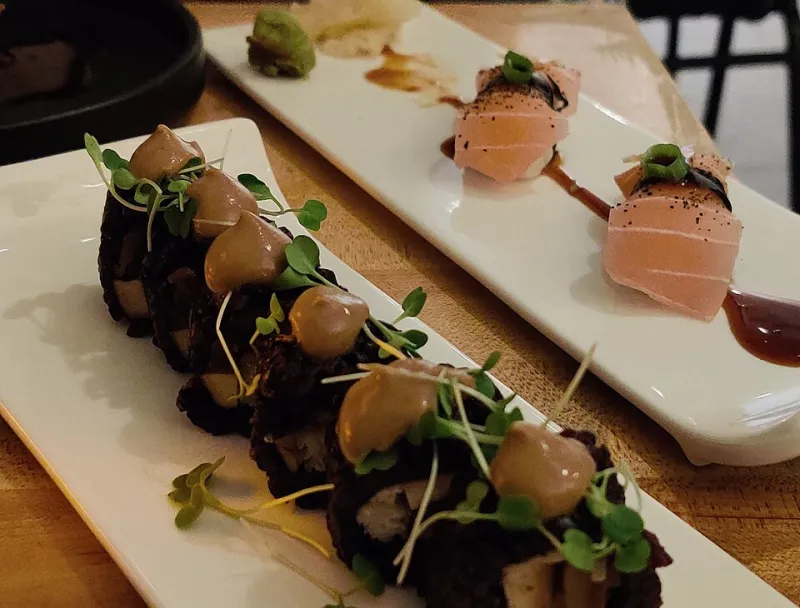
If you've ever ordered torched salmon or seared tuna at a fusion sushi spot, you've experienced the Maillard reaction firsthand — you just didn't know it had a name.
The Maillard reaction is a chemical process that occurs when proteins and sugars in food are exposed to high heat, typically above 280°F. It's the same thing that gives a grilled steak its crust, a toasted baguette its golden color, and your morning coffee its roasted depth. When a sushi chef runs a culinary torch across a slice of fatty salmon, they're not just warming it up. They're triggering hundreds of new flavor compounds that didn't exist in the raw fish a second before.
Here's where it gets interesting for fusion cuisine: traditional Japanese sushi was never really about applying heat to fish. The craft was built around raw freshness, the quality of the rice, and the balance of umami. Introducing controlled, targeted heat — not cooking the fish all the way through, just kissing the surface — is a distinctly modern innovation. But it works because the chefs understand the science. Too much heat and you've got cooked salmon. The right amount and you've unlocked a caramelized, slightly smoky top layer that contrasts beautifully with the cool, buttery fish underneath.
At Muse Fusion, that contrast is intentional. It's not a trick. It's thermodynamics.
Temperature Control: The Unsung Hero of Great Sushi Rice
Ask any sushi master what separates good sushi from great sushi, and nine times out of ten they'll talk about the rice before they ever mention the fish. Sushi rice — shari — is the foundation of everything, and its preparation is almost maniacally temperature-sensitive.
The ideal serving temperature for sushi rice is somewhere around 98°F, which is roughly body temperature. That's not a coincidence. At that temperature, the starch granules in the rice maintain a specific texture — slightly sticky but not gummy, with individual grains that hold together under light pressure but release cleanly in your mouth. Go too cold, and the starches retrograde, making the rice firm and chalky. Go too hot, and the vinegar seasoning becomes volatile, overwhelming the delicate flavor balance.
For fusion chefs, this creates an interesting challenge. When you're adding ingredients like spicy tuna, tempura crunch, or truffle oil to a roll, each component has its own ideal temperature range. The art — and the science — is in bringing them all together at the right moment so nothing gets compromised. A warm crispy element placed too early will steam itself soggy against the rice. A cold cream cheese added at the wrong stage can shock the rice temperature and throw off the entire texture.
Timing, it turns out, is everything.
The Umami Equation: Why Fusion Pairings Actually Make Sense
One of the most common critiques of fusion sushi is that it throws too many flavors at the wall and hopes something sticks. Sriracha here, mango there, maybe some jalapeño for good measure. From the outside, it can look chaotic.
But the best fusion chefs are actually working from a very deliberate framework: umami stacking.
Umami — often described as a savory, mouth-coating depth of flavor — comes from glutamates, inosinate, and guanylate compounds found in specific ingredients. Soy sauce is high in glutamates. So is miso. So are aged cheeses, mushrooms, and fermented products of all kinds. When you combine ingredients that each carry significant umami load, the effect is synergistic, not just additive. Two umami-rich ingredients together can taste exponentially more savory than either one alone.
This is why miso-butter on a piece of seared scallop nigiri makes your eyes close involuntarily. Miso brings fermented glutamates. Butter adds fat-soluble flavor compounds that carry and extend those glutamates across your palate. Scallop itself is naturally high in inosinate. Stack them together, and you've created a flavor bomb that's deeply satisfying on a neurological level — not just a trendy combination someone thought looked good on a menu.
Japanese cuisine has understood umami stacking intuitively for centuries. Fusion cuisine is just applying that same logic to new ingredient combinations.
Acid, Fat, and the Balance That Keeps Everything Honest
Here's something that doesn't get talked about enough in sushi circles: acid is just as important as umami.
Traditional sushi rice is seasoned with rice vinegar — that's acidity built right into the base. Pickled ginger (gari) served alongside your sushi isn't just a palate cleanser for show; it's a strategic acid reset between bites that keeps your taste buds from getting fatigued. Wasabi, too, has a sharp brightness that cuts through fat and refreshes the palate.
Fusion sushi layers additional acid sources — citrus zest, yuzu, ponzu, even the occasional splash of rice wine — to achieve the same balancing effect with bolder, richer ingredients. When you're working with tempura shrimp, spicy mayo, and cream cheese all in a single roll, you need that acid to keep the dish from feeling heavy. Without it, every bite after the third starts to taste like the same wall of richness.
Fat, meanwhile, is the vehicle. Ingredients like avocado, salmon belly, and Japanese Kewpie mayo don't just add flavor — they carry and distribute other flavor compounds across your palate in ways that water-soluble ingredients simply can't. This is why a roll with a thin layer of avocado can taste more cohesive than one without: the fat is literally binding the flavor experience together.
What This Means for the Future of Sushi
Understanding the science behind fusion sushi doesn't make it less magical. If anything, it makes it more impressive. The chefs who are doing this well — who are genuinely innovating rather than just stacking trendy ingredients — are working at the intersection of culinary tradition and applied chemistry every single day.
At Muse Fusion Sushi, that's the whole point. Every roll on the menu started as a question: why does this work? Not just does it taste good, but why does it taste good, and how do we make it taste even better? That curiosity is what drives the menu forward, and it's what keeps the food honest even when it's being adventurous.
Next time you bite into a torched nigiri or a roll with an ingredient combination that surprises you, pay attention to what's happening. There's a whole lot of science in there. And it's delicious.