Why the Way Your Sushi Looks Changes the Way It Tastes

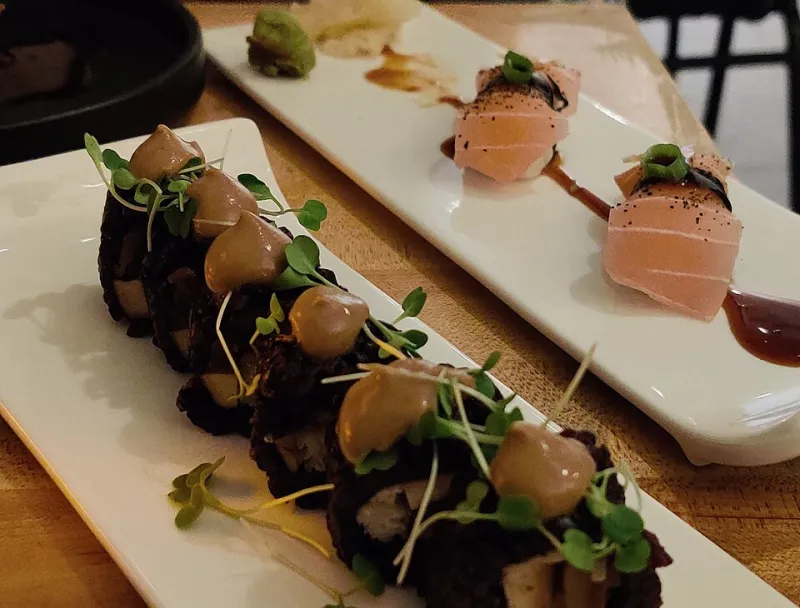
Photo: elegant sushi plating minimalist Japanese restaurant presentation, via greenweddingshoes.com
Before you eat a single piece of sushi, you've already started tasting it. Your brain is doing something remarkable the moment a plate lands in front of you — it's building an expectation, assembling a flavor prediction based entirely on what your eyes are taking in. And that prediction? It's not a passive preview. It actively changes how the food tastes once it hits your tongue.
This isn't a metaphor. It's neuroscience. And it has a lot to say about why a thoughtfully plated sushi spread at a restaurant like Muse Fusion Sushi hits differently than something assembled without intention.
Your Eyes Are Eating First
Researchers at Oxford University, led by experimental psychologist Charles Spence, have spent years studying what's called "crossmodal perception" — the way our senses bleed into and influence each other. In one well-known study, participants rated the same strawberry mousse as significantly sweeter and more flavorful when it was served on a white plate versus a black one. Same recipe. Same portion. Different visual context, different perceived taste.
Spence's research has shown that visual cues trigger anticipatory responses in the brain's reward system before a single calorie is consumed. We're not just looking at food — we're pre-tasting it. Color, arrangement, and even the direction food is plated on a dish can shift our perception of sweetness, umami intensity, and overall satisfaction.
For a cuisine as visually intentional as sushi, this is a big deal.
Color Contrast Does More Than Look Pretty
Traditional Japanese plating philosophy has always understood something that Western food culture is only recently catching up to: color contrast on a plate creates sensory tension that makes food more interesting to eat. The bright orange of tobiko against the ivory white of sushi rice. The deep green of avocado against a pale slice of yellowtail. A drizzle of dark eel sauce cutting across a clean white ceramic surface.
These aren't arbitrary choices. High contrast between food elements and their background increases what food scientists call "visual salience" — essentially, how much attention your brain pays to what it's about to eat. More attention means more anticipation. More anticipation primes your taste receptors to register flavor more intensely.
At Muse Fusion, where the menu bridges traditional Japanese technique and bold contemporary flavor, color isn't just a garnish decision. It's part of how a dish communicates what it's going to taste like before you've even picked up your chopsticks. A roll finished with a scatter of crispy shallots and a ribbon of microgreens is telling your brain: there's texture here, there's freshness, there's complexity. Your palate shows up ready for all of it.
Negative Space Is a Flavor Tool
One of the most striking differences between restaurant-quality sushi plating and home assembly is the use of negative space — the deliberate emptiness around food elements. In American dining culture, we often equate a full plate with value. More coverage, more food, more satisfaction. But from a perceptual standpoint, negative space does something counterintuitive: it makes the food that is on the plate taste more.
When a single piece of nigiri sits in the center of a wide, clean slate plate with nothing crowding it, your brain treats it as something important. Something worth paying attention to. Research in sensory marketing has found that sparse, deliberate plating increases perceived quality and flavor intensity — diners literally rate the taste higher when the same food is presented with more surrounding space versus crammed edge to edge.
This is why the omakase aesthetic — minimalist, intentional, unhurried — has been so influential in contemporary sushi culture. The empty space isn't absence. It's emphasis.
Arrangement Tells a Story Your Brain Follows
Beyond individual elements, the overall arrangement of a sushi plate communicates narrative structure. Dishes that build from lighter to bolder flavors — visually telegraphed through color progression or height variation — guide diners through an experience rather than just presenting a collection of food.
Studies on visual composition and taste have found that asymmetrical, organic arrangements tend to be perceived as more flavorful and "natural" than perfectly symmetrical layouts, which can read as artificial or overly controlled. This tracks with the Japanese aesthetic concept of wabi-sabi — an appreciation for natural imperfection and the beauty of things that feel alive rather than manufactured.
Modern fusion plating plays with this constantly. A roll that's precisely constructed but finished with a casual scatter of sesame seeds and a loosely draped shiso leaf is balancing order and spontaneity — and your brain reads that balance as this was made by someone who knows what they're doing. Perceived expertise elevates perceived flavor. It's a loop.
The Vessel Matters More Than You Think
The plate itself — its shape, material, and color — is part of the flavor equation. Research has shown that food served on angular or sharp-edged dishes is perceived as more bitter or intense, while rounded vessels push perception toward sweetness and softness. Matte finishes tend to make food feel more natural and artisanal; glossy surfaces can heighten the sense of richness or indulgence.
At a fusion sushi restaurant, the choice between a dark slate board, a white ceramic rectangle, or a wooden vessel isn't just aesthetic branding. It's flavor design. A smoky salmon dish served on dark slate reinforces the depth and intensity of the flavor profile. A delicate citrus-forward ceviche-style preparation on white ceramic lets the brightness land clean.
This is the kind of layered intentionality that separates a thoughtfully designed dining experience from simply eating food off a surface.
Why This All Matters for How You Eat
Understanding the psychology of presentation doesn't make you a snob — it makes you a more aware eater. When you sit down to a meal and notice that you're genuinely enjoying it more than you expected, the plating might be doing more work than you realize. Your brain is being guided, gently and expertly, toward a richer experience.
At Muse Fusion Sushi, the fusion philosophy isn't just about what goes into a roll — it's about how the whole sensory experience is constructed. Bold ingredients deserve bold presentation. Traditional techniques deserve the kind of visual respect that lets them speak clearly. And the diner deserves a plate that's already building flavor before the first bite.
Next time a dish arrives and you feel that little moment of oh, that's beautiful — pay attention. Your taste buds are about to agree.