Against the Clock: The Hidden Timing Rules That Make or Break Every Sushi Experience
Photo: בר, CC BY-SA 3.0, via Wikimedia Commons
You've probably had the experience of eating sushi that was technically fine but somehow felt flat. The fish was fresh, the rolls looked the part, but something was off in a way you couldn't name. Nine times out of ten, timing was the culprit. Not the fish. Not the knife work. Not even the rice — well, actually, almost always the rice. But we'll get there.
There's an invisible architecture to a great sushi meal that most diners never see, and most restaurants never bother to build. The best sushi chefs treat the sequence and pacing of a meal the way a conductor treats an orchestra — every element has its moment, and when one piece is off, the whole thing falls apart.
The Rice Window You Never Knew Existed
Let's start with the foundation. Sushi rice — or shari, as it's called in Japanese tradition — is arguably the most time-sensitive ingredient in the entire meal. It's seasoned while hot, so the vinegar, salt, and sugar absorb properly. But it needs to cool to a very specific temperature before it's usable: roughly body temperature, around 98°F. Too cold, and the starch firms up, giving you that gummy, refrigerator-brick texture that ruins so many grocery store rolls. Too hot, and it wilts whatever fish you place on top.
That window — between too hot and too cold — is surprisingly narrow. And it doesn't stay open long. Once the rice has been formed into nigiri, the clock starts ticking again. The warmth of the rice slowly begins to affect the fish above it, slightly changing the fat structure and texture in ways that are subtle but real. Most chefs will tell you a properly made piece of nigiri is at its peak within about 60 to 90 seconds of being formed. After that, it's still good. But it's not that.
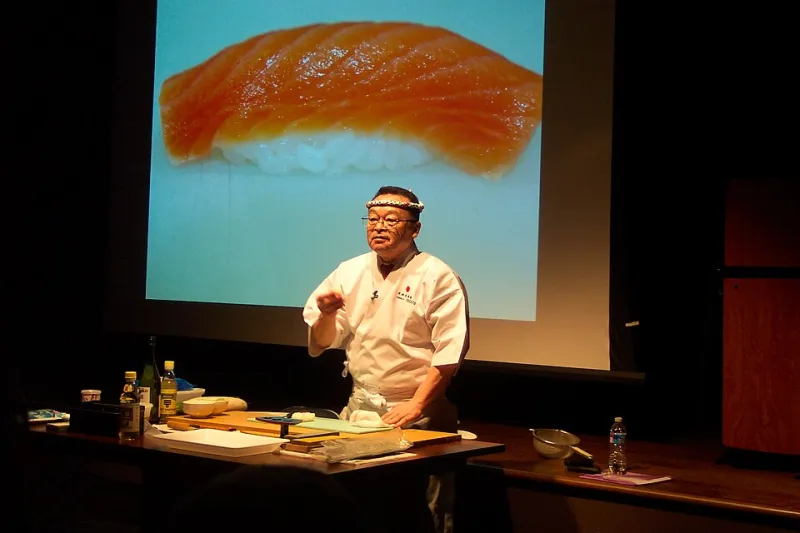
This is why omakase counters — where you sit directly in front of the chef — exist. The chef forms a piece, sets it in front of you, and the unspoken expectation is that you eat it immediately. The whole setup is engineered around that 60-second window.
What Happens When Restaurants Ignore the Clock
In a busy restaurant, sushi often gets plated, set on a pass, picked up by a server, carried across a dining room, and delivered to a table — a process that can easily take three to five minutes. For rolls, that's usually fine. The structure holds. But for nigiri, that delay matters.
The rice cools and firms. The fish, which was gently warmed by the rice below it, either gets cold from the ambient air or loses that perfect contrast of temperatures. The nori on a hand roll — one of the most time-sensitive items on any sushi menu — starts to soften the moment it contacts the rice's moisture, and within a few minutes, that satisfying crunch is completely gone. A soggy hand roll is a small tragedy that didn't have to happen.
None of this is the diner's fault. Most people don't know to eat their hand roll the second it lands on the table. But the best sushi restaurants solve this problem before it starts — either by designing service so the timing works, or by training servers to communicate urgency without making guests feel rushed.
Pacing as an Art Form
Beyond individual pieces, there's the larger question of how a full sushi meal flows from start to finish. In traditional omakase dining, this is highly intentional. A chef might begin with lighter, more delicate fish — flounder, sea bream, snapper — to calibrate your palate before introducing richer cuts like fatty tuna or uni. The progression is like a musical key change: you're being moved somewhere, even if you don't notice it happening.
There's also the question of rest. A good sushi chef knows when to slow down, letting a guest sit with a particularly complex piece rather than immediately presenting the next one. That pause isn't awkward — it's part of the meal. It's the equivalent of a musician letting a note breathe.
In a more casual setting, like a fusion restaurant where the menu is broader and the vibe is less ceremonial, this kind of pacing takes a different form. At Muse Fusion Sushi, where we're blending traditional Japanese craft with the energy of modern American dining, timing still matters — it just has to fit a different rhythm. A table ordering a mix of rolls, nigiri, and small plates needs a kitchen that understands sequencing. Hot dishes shouldn't sit while cold ones are being plated. Delicate sashimi shouldn't arrive after a heavy, sauce-forward roll has already coated your palate.
The Temperature Gradient Most People Never Notice
Here's something worth slowing down for: great nigiri is not a uniform temperature. The fish on top is cool, sometimes close to fridge-cold. The rice underneath is warm. When you eat a piece of nigiri correctly — in one bite, fish-side down against your tongue — you experience both temperatures at once. That contrast is intentional. It's part of the design.
When a piece sits too long, those temperatures equalize. Everything becomes room temperature, and that contrast disappears. The experience flattens. You're eating the same ingredients, but you're not eating the same dish.
This is why the "eat it now" instinct at a great sushi counter isn't just etiquette. It's actually the right move for your own enjoyment.
Reading the Room: Timing Signals Worth Knowing
You don't need to be a sushi expert to pick up on good timing. A few things to look for:
- The chef watches you eat. At a counter, a good itamae will make eye contact or glance your way after serving a piece. They're timing the next one to your pace.
- Hand rolls arrive separately. Any restaurant that sends a hand roll out with a platter of other items doesn't understand — or doesn't care — that it needs to be eaten first.
- Nigiri comes in small batches. Two or three pieces at a time is intentional. It keeps each serving within that optimal window.
- There are natural pauses. If the meal feels like it has a rhythm — moments of intensity followed by lighter moments — someone in the kitchen is thinking about the experience, not just the food.
The best sushi meals feel almost effortless, like time is passing exactly as it should. That feeling isn't an accident. It's the result of a kitchen running against the clock in ways you'll never see — and never need to. Your only job is to eat the piece while it's still perfect.