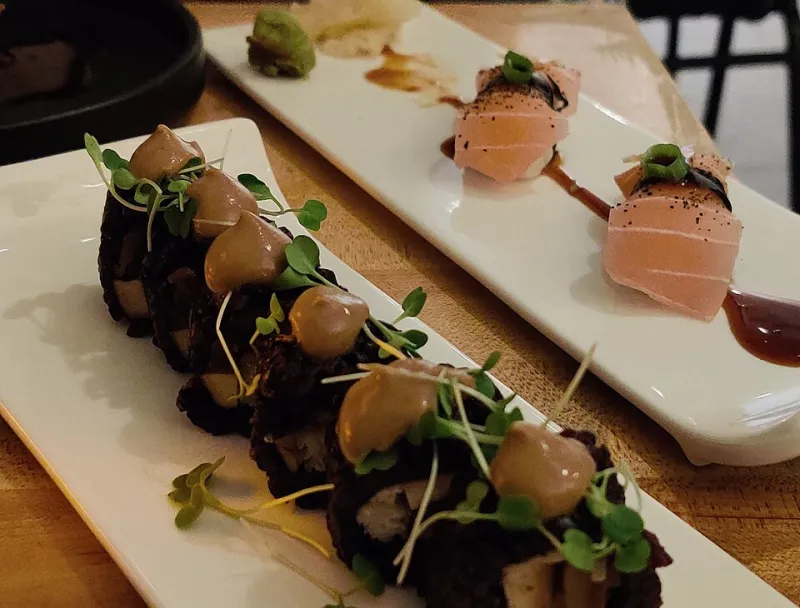
Why Watching Your Sushi Get Made Might Be the Best Ingredient of All
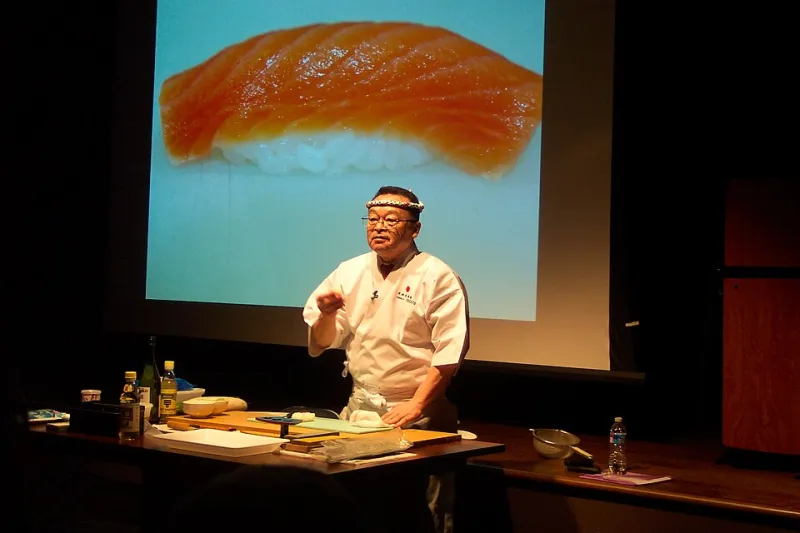
Photo: Geraldshields11, CC BY-SA 3.0, via Wikimedia Commons
Picture two identical plates of nigiri. Same fish, same rice, same ratio of soy to wasabi. One arrives in a delivery bag, tucked into a styrofoam tray, lid slightly fogged from the commute. The other is placed in front of you by the chef who just made it, thirty seconds after the final slice. The fish hasn't changed. The flavor profile is technically the same.
And yet — they don't taste the same. Not even close.
This isn't nostalgia talking, and it's not snobbishness. It's psychology. And once you understand what's actually happening in your brain when you watch food get made, you'll never look at a sushi counter the same way again.
The Theater Has Always Been Part of the Meal
Japanese omakase dining has understood something that Western restaurant culture is only recently catching up to: the experience of eating begins long before the first bite. In a traditional omakase setting, you sit at the counter, close enough to watch the chef's hands. You see the fish being sliced. You watch the rice being shaped. You notice the deliberate, unhurried precision of every movement.
This isn't incidental to the meal. It is the meal — at least partly. The ritual of watching creates a specific kind of anticipation that primes your senses before any food reaches your mouth. Your brain starts building a flavor expectation based on visual cues, smell, sound (the soft thud of a knife, the gentle press of rice), and even the body language of the chef. By the time the nigiri lands in front of you, you've already begun tasting it in your head.
American dining culture is increasingly hungry for this kind of experience, even if diners can't always articulate why. Open kitchens, chef's tables, and counter-service sushi spots are all growing in popularity — and the psychology behind that trend is worth unpacking.
What Behavioral Science Says About Watching Your Food Get Made
Researchers have a name for what happens when you invest effort or attention in something before receiving it: the IKEA effect. Named after the furniture company that famously requires you to assemble your own shelves, the principle is simple — when you participate in a process, even passively, you assign more value to the outcome.
Applied to food, this is fascinating. Studies have shown that people consistently rate food as tasting better when they watch it being prepared versus when it simply appears in front of them. The act of observation creates a sense of participation. You didn't make the sushi, but you witnessed it. You tracked its progress. You have a relationship with that specific piece of food that you simply don't have with something that materialized from a delivery bag.
There's also something happening with anticipation specifically. Dopamine — the neurotransmitter most associated with pleasure — actually peaks during the anticipation of a reward, not during the reward itself. Watching a chef work builds that anticipation deliberately and sustainably. By the time you eat, your brain's reward circuitry is already primed and firing. The food doesn't have to work as hard to satisfy you, because you've been building toward satisfaction for the past several minutes.
The Trust Factor: Transparency as a Flavor Enhancer
There's another layer to this that's particularly relevant for sushi, where freshness isn't just a preference — it's a safety consideration for many diners. Watching your food get made builds trust in a way that no menu description or five-star review can fully replicate.
When you see the fish come out of the case, watch the chef inspect it, and observe the sanitary precision of the preparation, you're not just entertained. You're reassured. And that reassurance removes a subtle but real layer of background anxiety that can otherwise color the entire dining experience. Eating without that low-level worry tastes different. It tastes better.
This is one reason why the open-kitchen trend in American restaurants isn't just aesthetic. It's a functional choice that changes the psychological contract between kitchen and customer. It says: we have nothing to hide, and we want you to see exactly what we're doing. For a cuisine like sushi, where the quality of ingredients is so central and so visible, that transparency carries enormous weight.
Counter Dining vs. Delivery: An Honest Comparison
None of this means delivery sushi can't be great. It absolutely can be. But it's worth being honest about what you're trading when you choose the convenience of ordering in versus sitting at a counter.
Delivery optimizes for accessibility. You get restaurant-quality food in your living room, which is genuinely remarkable and worth celebrating. But the psychological scaffolding that enhances the in-person experience — the anticipation, the trust, the participation — doesn't travel. The food arrives as a finished object, disconnected from its own creation story.
Counter dining, by contrast, is immersive in a way that multiplies the value of every ingredient on the plate. The same fish, the same rice, the same chef's skill — experienced at the counter rather than on your couch — registers as a more satisfying meal. Not because the food is objectively better, but because your brain is more fully engaged in receiving it.
For special occasions, or for any meal where you want to be fully present, there's a strong case for choosing the counter every time.
What This Means for How You Order
If you can't always make it in for counter service — and let's be real, most of us can't — there are still ways to bring some of this psychology home. Choosing restaurants with visible preparation standards (even through photos or video content) helps build the kind of trust that makes food taste better. Reading about how a dish is made before you eat it creates a small but real version of the anticipation loop.
And when you do have the chance to sit at a sushi counter? Put your phone away. Watch the chef. Let the anticipation build. The food will taste better for it — not because anything on the plate changed, but because you showed up fully to the experience.
That's the part of the meal no delivery app can replicate. And honestly, it might be the most important ingredient of all.