Miso Butter, Spicy Mayo, and the Ancient Logic Behind Modern Sushi Flavors
Photo: Karen and Brad Emerson, CC BY 2.0, via Wikimedia Commons
The Accusation Every Fusion Chef Has Heard
Somewhere between the spicy tuna roll and the truffle ponzu drizzle, someone at the table inevitably says it: "This isn't real sushi." It's a familiar critique, and on the surface, it seems reasonable. Miso butter? Sriracha mayo? These sound like ingredients that wandered in from a California kitchen and never left.
But here's the thing — if you actually dig into the science of Japanese flavor, those "fusion" ingredients start to look a lot less like cultural borrowing and a lot more like a natural continuation of something Japan figured out centuries ago. We're talking about umami, the so-called fifth taste, and the reason why miso butter on a piece of grilled salmon feels less like a departure from tradition and more like tradition finally meeting its moment.
What Umami Actually Is (And Why Japan Invented the Word)
Umami is often described as savory, but that sells it short. It's the deep, lingering, mouth-coating sensation that makes you want to keep eating something even after you're technically full. The word itself was coined in 1908 by Japanese chemist Kikunae Ikeda, who isolated glutamate — a naturally occurring amino acid — as the compound responsible for the irresistible flavor in dashi broth.
Glutamate doesn't work alone, though. It amplifies other flavors, creates a sense of roundness and depth, and interacts powerfully with two related compounds: inosinate (found in meat and fish) and guanylate (found in dried mushrooms). When these molecules combine, the umami effect doesn't just add — it multiplies. Japanese cuisine has been engineering this synergy for centuries through ingredients like kombu, dried bonito, fermented miso, soy sauce, and aged fish.
The entire foundation of traditional Japanese cooking is essentially an exercise in stacking umami sources to create maximum depth with minimal fuss. Which brings us to the ingredients in question.
Miso Butter: A Fermented Powerhouse with a French Accent
Miso paste is one of the oldest and most umami-dense ingredients in the Japanese pantry. Made from fermented soybeans (and sometimes rice or barley), miso is loaded with glutamate produced during the fermentation process. It's been a cornerstone of Japanese cooking for over a thousand years, used in everything from soup to marinades to glazes for grilled fish.
Butter, on the other hand, is obviously not Japanese in origin. But here's where it gets interesting: butter is high in fat, and fat is a powerful flavor carrier. When you combine miso's concentrated glutamate hit with butter's creamy, fat-rich body, you get something that amplifies the miso's savory depth while simultaneously softening its intensity. The result is a compound that coats the palate and extends the flavor experience in a way that feels almost engineered for satisfaction.
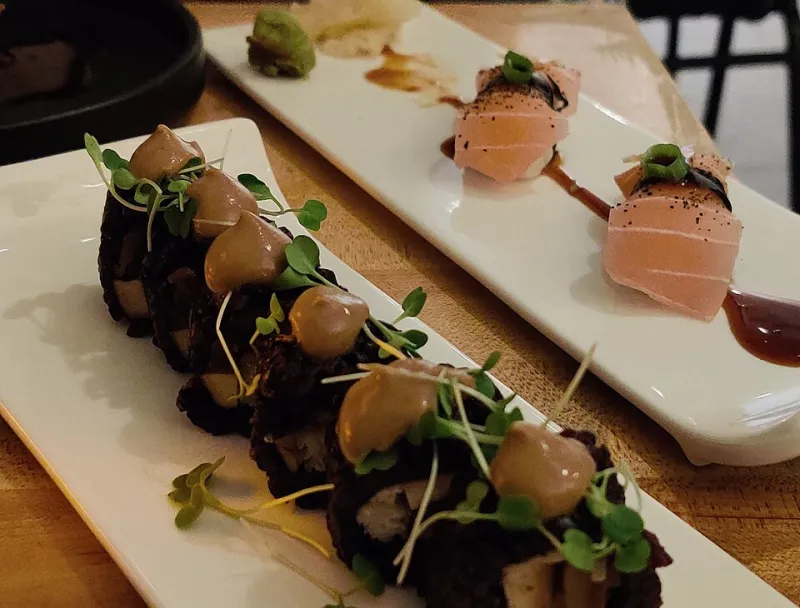
In fact, the pairing is so intuitive that Japanese home cooks have been making variations of miso-butter corn (a beloved street food) for decades. Contemporary chefs who swirl it onto sushi rice or brush it over a torched scallop aren't reinventing anything — they're just applying the same logic to a new canvas.
Sriracha Mayo: The Capsaicin-Umami Connection
Spicy mayo has become so ubiquitous in American sushi restaurants that it's easy to forget it has a legitimate flavor science story behind it. The base — Japanese kewpie mayonnaise — is itself a umami powerhouse. Unlike American mayo, kewpie is made with egg yolks only (rather than whole eggs) and seasoned with rice vinegar and a touch of MSG. It's richer, tangier, and significantly more savory than its Western counterpart.
Add sriracha, and you're introducing capsaicin into the mix. Capsaicin doesn't just bring heat — it triggers a physiological response that increases saliva production and heightens taste sensitivity. Essentially, a little heat primes your palate to perceive flavor more intensely. That means when spicy mayo hits a piece of fatty tuna, the fat and umami in the fish register more vividly than they would on their own.
Japanese cuisine has long understood the role of contrast in flavor. The sharp acidity of pickled ginger, the sinus-clearing punch of wasabi — these aren't just palate cleansers. They're reset buttons that keep every bite tasting as vivid as the first. Spicy mayo operates on a similar principle, using heat to keep the umami experience dynamic rather than flat.
Fusion as Fluency, Not Forgery
Here's the broader point: Japanese culinary philosophy has never been rigidly closed. Tempura, now considered a quintessential Japanese dish, was introduced by Portuguese missionaries in the 16th century. Ramen has Chinese roots. Yoshoku — the Japanese take on Western dishes like omurice and hamburg steak — became a beloved domestic cuisine precisely because Japanese cooks absorbed foreign influences and filtered them through their own flavor logic.
What contemporary fusion chefs are doing with miso butter and sriracha mayo is part of the same continuum. They're not abandoning Japanese flavor principles — they're fluent enough in those principles to apply them to new ingredients. The question was never "Is this ingredient Japanese?" The real question has always been: "Does it serve the flavor?"
When the answer is yes — when a swirl of miso butter deepens the umami of a seared piece of fish, or when spicy mayo makes a fatty roll come alive — the ingredient earns its place at the table, regardless of its passport.
The Takeaway for Your Next Sushi Order
Next time you're scrolling through the menu and you spot something like a yuzu kosho aioli or a white miso glaze, don't think of it as a gimmick. Think of it as a chef who understands the science of Japanese flavor well enough to build on it. The best fusion isn't a collision between two culinary traditions — it's a conversation. And as it turns out, umami has always been the common language.