All Five Senses, All at Once: The Wild Science Behind Sushi That Messes With Your Mind
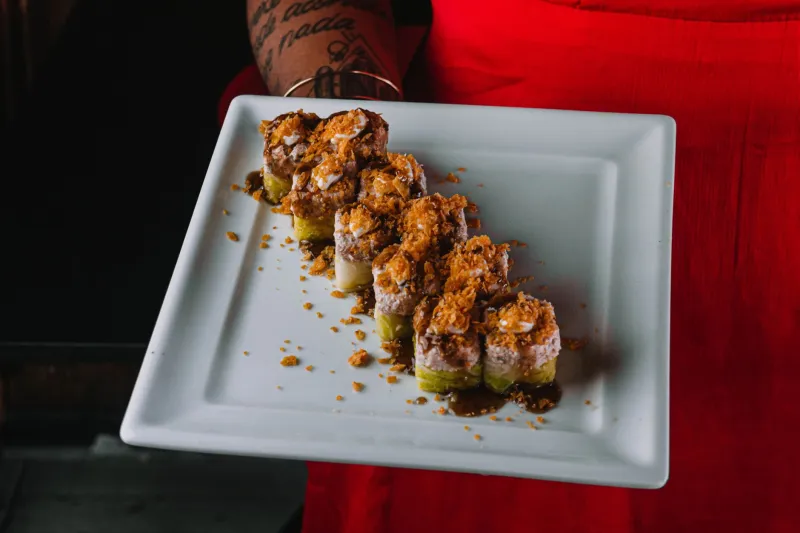
Picture this: a roll arrives at your table on a slate-black plate. The rice glows faintly under a citrus-yuzu gel. A strip of crispy shallot shatters the moment your teeth close around it. There's a faint smokiness drifting up before you've even taken a bite. Somewhere in the background, low-frequency bass pulses through the dining room floor. By the time flavor actually hits your tongue, your brain has already been primed, prodded, and partially convinced that this is the best thing you've ever eaten.
Welcome to the multi-sensory sushi experience — and it's more calculated than you might think.
What Even Is Synesthesia, and Why Are Chefs Obsessed With It?
Synesthesia is a neurological phenomenon where stimulation of one sense automatically triggers another — some people hear music and see colors, or taste words. It sounds like something out of a science fiction novel, but chefs have quietly been borrowing from this concept for years, deliberately blurring sensory lines to manufacture stronger, more memorable eating experiences.
In the fusion sushi world specifically, this obsession has hit a fever pitch. The thinking goes something like this: if your brain is already processing visual information, texture, temperature, and ambient sound before a flavor registers, then the flavor itself arrives loaded with context. And context, as it turns out, is a huge part of what makes food taste good.
Dr. Charles Spence, an experimental psychologist at Oxford who studies crossmodal perception (basically, how our senses influence each other), has published research showing that the color of a plate can change how sweet or salty food tastes. That the weight of a utensil affects perceived food quality. That crunchy sounds make food taste fresher. Chefs at the cutting edge of fusion cuisine have been reading this research — and running with it.
The Chef's Perspective: Engineering a Memory, Not Just a Meal
Talk to enough fusion sushi chefs and a pattern emerges. They're not just thinking about flavor profiles in isolation anymore. They're thinking about the full arc of a dining moment — from the second a dish is set down to the last thing a guest remembers an hour later.
"When I design a roll, I'm asking myself what the guest sees first, what they hear when they bite, what temperature hits their palate, and only then — what the flavor does," says one chef working in the modern omakase space. "If any one of those layers is missing or mismatched, the whole thing falls flat."
This is a significant shift from traditional sushi philosophy, which prizes restraint and lets singular, pure ingredients do the talking. Fusion chefs aren't dismissing that tradition — many of them trained in it — but they're layering on top of it, using sensory science as an additional toolkit.
The visual element tends to come first. A roll plated with edible flowers, microgreens, or a thin sheet of gold leaf isn't just aesthetic flex. Research consistently shows that visually complex or beautiful food is rated as tasting better before a single bite is taken. The brain has already made a judgment call.
Then comes sound. The crunch factor in modern fusion sushi — tempura flakes, toasted quinoa, puffed rice, crispy skin — isn't just about textural contrast for its own sake. It's partly about the acoustic signal that crunch sends. A loud, clean snap registers as freshness and quality, almost involuntarily.
Temperature layering adds another dimension. A roll that combines cold, barely-set fish with warm, just-seared elements forces the brain to process two simultaneous thermal signals, which research suggests heightens overall sensory attention. You're more alert. More present. More likely to actually taste what's in front of you.
The Smell Problem Nobody Talks About
Of all five senses, smell is the one fusion sushi menus tend to underutilize — which is strange, given that aroma accounts for a massive portion of what we perceive as flavor. The nose-to-brain pathway is the most direct sensory route we have, bypassing the thalamus entirely and connecting straight to memory and emotion centers.
A few chefs are starting to close this gap deliberately. Think tableside presentations involving a puff of smoke, or rolls served alongside a small dish of toasted sesame oil and citrus peel that guests are encouraged to inhale before eating. Some higher-end fusion spots have experimented with scent diffusers calibrated to the current course — cedar for a salmon dish, ocean air for a tuna presentation.
It sounds theatrical, and honestly, it is. But the science backs it up. Priming the olfactory system before eating can increase flavor intensity by a measurable margin. You're essentially giving your brain a heads-up about what's coming, and it responds by tuning in.
When Sensory Maximalism Becomes Too Much
Here's the honest counterpoint: not everyone loves this approach, and the critics have a point.
When every element of a dish is screaming for attention simultaneously, the experience can tip from delightful to exhausting. There's a concept in sensory psychology called "attentional resource depletion" — essentially, your brain has a finite capacity to process incoming stimuli, and when that capacity gets maxed out, the experience becomes less enjoyable, not more.
Some diners leave multi-sensory tasting menus feeling vaguely fatigued without knowing why. They describe the food as impressive but somehow unsatisfying. This is likely what's happening: the sensory engineering was so thorough that the brain never got a moment to just settle into the flavor.
Traditional sushi, by contrast, creates space. A single piece of nigiri on a plain ceramic dish, no garnish, no theater — it forces all of your attention onto the fish, the rice, the brief flash of wasabi. The restraint is the point. And that restraint is neurologically sound: focused attention on a single input often produces more intense, more meaningful experiences than divided attention across many.
The best fusion chefs seem to understand this intuitively. They use multi-sensory layering strategically, not constantly. A tasting progression might include two or three deliberately engineered sensory moments, bookended by simpler, quieter bites that give the palate — and the brain — room to breathe.
Finding the Balance
The synesthesia trap, as some in the industry call it, is the temptation to keep adding. One more textural element. One more visual flourish. One more ambient sound cue. The logic feels sound in isolation — more inputs, stronger experience — but it doesn't scale linearly. At some point, the experience stops being about the food.
The chefs doing this best treat sensory science like seasoning: used with intention, in the right amounts, in the right moments. They know when to turn the volume up and when to let silence do the work. The result isn't just a meal that tastes good. It's a meal that sticks — the kind you're still thinking about on the drive home, trying to figure out exactly what just happened to you.
And maybe that's the whole point.