Sharp Truths: How the Blade Behind Your Sushi Changes Everything You Taste
Ask anyone what makes great sushi and you'll hear the usual suspects: fresh fish, properly seasoned rice, maybe a little wasabi that's actually the real thing. What almost nobody mentions is the knife. Which is wild, because in a traditional Japanese kitchen, the blade isn't just a tool — it's essentially the final ingredient.
That might sound like chef mysticism, but there's genuine science behind it. And as fusion-forward sushi culture continues to evolve here in the US, knife craft is finally getting the attention it deserves — both in professional kitchens and among serious home cooks who want to close the gap between what they make and what they eat at a great omakase counter.
What a Dull Blade Actually Does to Your Fish
Here's the thing most people don't realize: cutting is a form of trauma. Every time a blade passes through fish flesh, it's disrupting cell walls. The question is how it disrupts them — and that's where sharpness becomes a flavor issue, not just a technique one.
A sharp, single-bevel Japanese knife like a yanagiba slices cleanly through muscle fibers with minimal lateral pressure. The cells stay largely intact. What you get on the plate is fish that holds its moisture, maintains its texture, and releases flavor gradually as you chew — the way it's supposed to.
A dull blade, or even a sharp Western-style knife with a double bevel, does something different. It pushes through tissue rather than slicing it, creating microscopic tears and crushing the cellular structure along the cut edge. You lose moisture to oxidation faster. The surface texture changes — sometimes barely perceptibly, sometimes dramatically. And the flavor? It peaks too early and fades.
"Most people can't articulate why a piece of tuna tastes different when it's been sliced wrong," says Marcus Liao, executive chef at a contemporary Japanese-American restaurant in Los Angeles. "They just know something feels off. Nine times out of ten, it's the cut."
The Yanagiba and Why It Became a Standard
The yanagiba — literally "willow blade" — is the workhorse of sashimi and nigiri prep in traditional Japanese kitchens. Its long, slender, single-bevel design lets a skilled chef pull the blade through fish in a single, fluid motion. No sawing. No pressure. Just a clean draw that separates the flesh almost surgically.
That single-bevel grind is important. Because only one side of the blade is angled, the flat back side acts as a guide against the fish, keeping the cut perfectly level. The result is slices with a consistent thickness and a smooth, almost polished surface — which isn't just about looks. A smooth cut surface means more even contact with your palate when you eat, which translates directly into how flavor registers.
Contrast that with a rocking chop from a standard chef's knife, and you start to understand why Japanese knife culture developed the way it did. These aren't aesthetic preferences. They're functional optimizations built over centuries of working with delicate proteins.
Texture Is Taste — and Blade Angle Controls Both
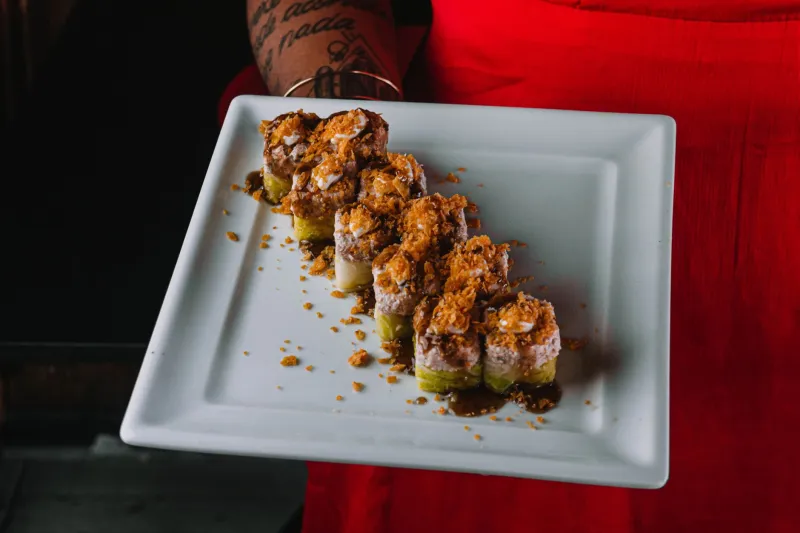
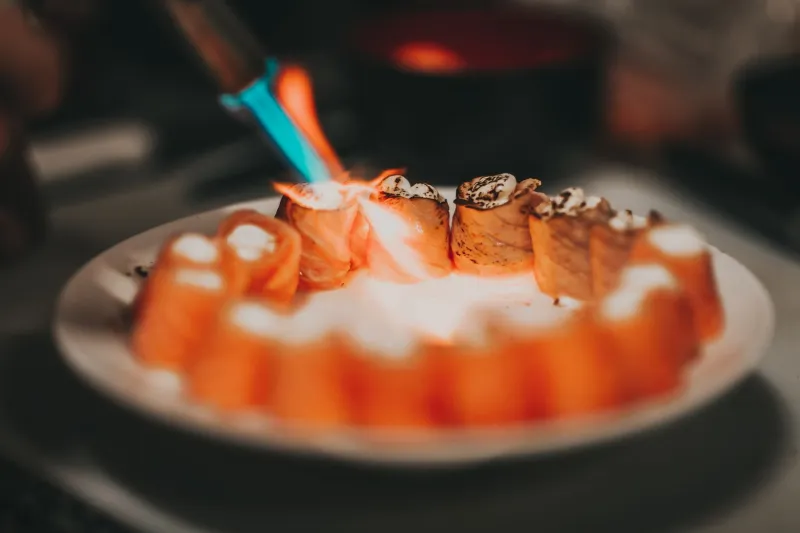
Fusion sushi has introduced a lot of exciting variables into the equation — torched salmon, crispy shallots, citrus-forward ponzu, heat from American-style hot sauces. But here's the underappreciated reality: all of those bold additions interact with the base texture of the fish. And base texture is almost entirely a product of how that fish was cut.
Chef Yuki Tanaka, who runs a hybrid omakase-and-fusion counter in Chicago, puts it bluntly: "When I'm working with a fatty piece of yellowtail and I want the butter flavor to come through before the heat from a jalapeño finishes it, I need the cut to be precise. If the slice is uneven, the fat releases at the wrong moment. The whole sequence falls apart."
This is the kind of nuance that separates technically excellent sushi from merely good sushi. In a fusion context — where you're already layering unfamiliar flavors and textures — having the foundational protein cut correctly becomes even more critical. The knife isn't competing with your toppings. It's setting the stage for them.
What American Kitchens Are Finally Getting Right
For a long time, Japanese knife craft was treated as a niche interest in the US — something for serious enthusiasts or culinary school graduates who'd done a stage in Japan. That's changing fast. Japanese knives have exploded in mainstream American cooking culture over the last decade, driven partly by YouTube rabbit holes, partly by the growth of Japanese food culture broadly, and partly by a new generation of chefs who refuse to accept the old divide between "professional" and "home" standards.
Retail shops and online knife communities have made yanagibas, deba knives, and usuba accessible at a range of price points. You don't need to spend $800 on a hand-forged blade to get meaningfully better results — though if you want to, that world absolutely exists. Even a well-maintained mid-range Japanese knife, properly sharpened on a whetstone, will outperform a neglected high-end Western knife every time.
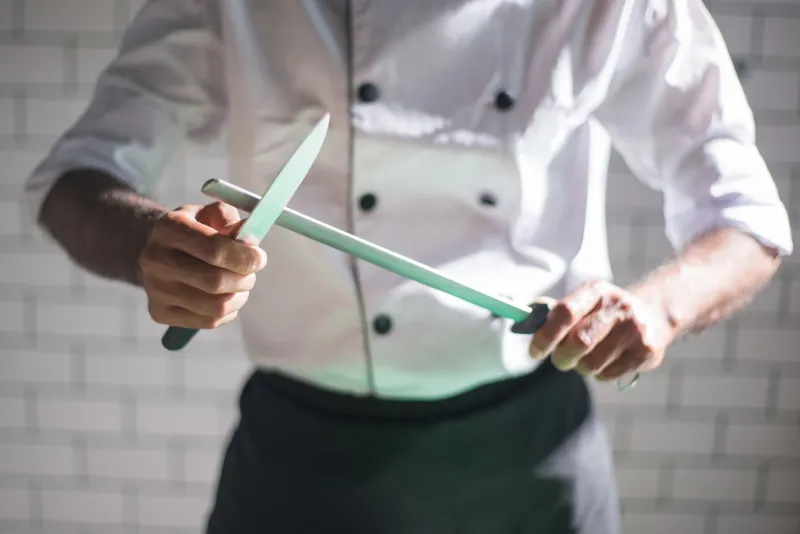
The maintenance piece is crucial. A knife that cost $200 and hasn't been sharpened in a year is functionally a dull knife. Sharpness isn't a feature you buy once — it's something you maintain. Many sushi chefs sharpen their blades daily, sometimes multiple times during a single service.
What to Look for When You're Eating Out
You don't need to be a knife nerd to notice the difference in your sushi. There are a few easy things to watch for next time you're at a sushi counter:
Edge consistency. Does each piece look like it was cut with intention, or does the thickness vary? Uneven cuts usually mean the knife work was rushed or the blade wasn't up to the task.
Surface texture. High-quality cuts have a slight sheen — the surface is smooth and slightly translucent. Rough, ragged edges on sashimi are a giveaway that something went wrong at the cutting board.
Moisture retention. Fish that's been cut well holds its moisture for longer. If your sashimi looks dry or dull before you've even touched it, that's often a knife issue compounded by time.
The chew. This one is harder to quantify, but pay attention to how the fish breaks down as you eat. Clean cuts produce a clean, even chew. Torn or compressed cuts can feel slightly stringy or mushy in ways that are hard to pin down but easy to notice once you're aware of them.
The Blade as Part of the Recipe
At Muse Fusion Sushi, we love the intersection of tradition and innovation — the moment where centuries of Japanese culinary wisdom meets the boldness of American cooking culture. Knife craft lives right at that intersection. It's one of the most ancient, most refined skills in the Japanese kitchen, and it's also one of the most practical upgrades available to anyone who's serious about sushi, whether they're eating it or making it.
The next time you sit down to a great piece of nigiri, take a second before you eat it. Look at the cut. Notice the surface. Then consider that somewhere between the fish and your plate, a chef made a hundred small decisions — and the sharpest one might have been the blade they chose.