Crunch Time: How the Rise of Textural Contrast Is Rewriting the Rules of Modern Sushi
There's a moment every sushi lover knows. You pick up a roll, take a bite, and instead of the expected smooth, yielding texture — there's a crack. A crunch. Something crispy wedging itself between layers of rice and fish in a way that feels almost wrong. And then, almost immediately, it feels completely right.
That paradox is at the center of one of the most interesting conversations happening in contemporary sushi right now. A cuisine historically defined by restraint, precision, and a near-religious respect for raw ingredients is increasingly embracing one of the most American of all food cravings: the need for something crispy.
Sushi's Quiet Obsession With Contrast
Here's the thing — texture in Japanese cuisine has never been an afterthought. Traditional sushi masters have always thought carefully about the interplay between the slight chew of properly seasoned rice, the clean give of fresh fish, and the faint resistance of nori. These are textures, just subtle ones.
What's changed is the volume. Where traditional Japanese sensibility whispers texture, modern fusion sushi is turning it up to a shout.
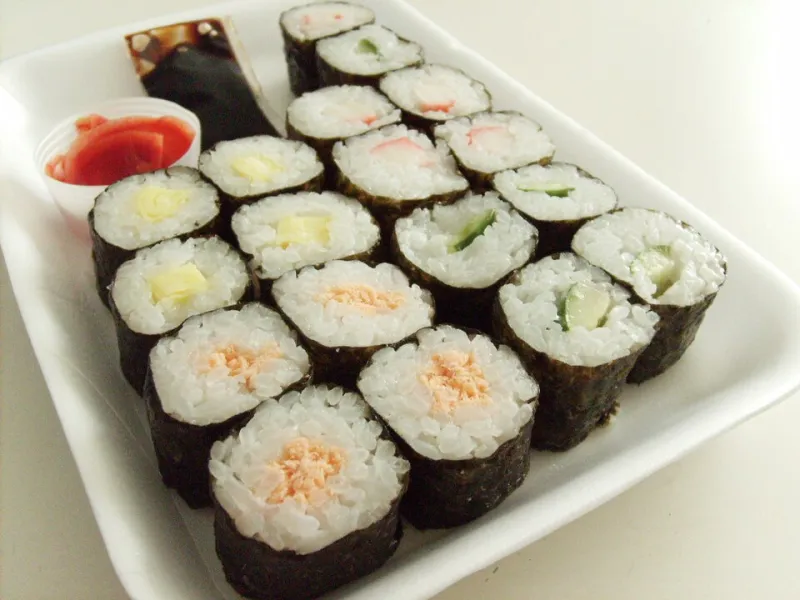
Chef Marcus Tanaka, who runs a fusion omakase counter in Austin, Texas, puts it this way: "Japanese cuisine has always had textural contrast — think of the crunch in a cucumber roll, or the snap of well-toasted nori. What we're doing now is just amplifying that conversation. We're making the contrast louder on purpose."
And American diners, it turns out, are very much here for it.
The Brain on Crunch
There's actual science behind why crunch is so irresistible. Food psychologist Charles Spence at Oxford University has studied how the sound of eating affects perceived enjoyment — and crunch is one of the most universally pleasurable food sounds humans experience. It's associated with freshness, energy, and even a kind of primal satisfaction that softer textures simply can't deliver.
When you bite into a roll topped with crispy tempura flakes, your brain is processing two signals at once: the softness of the fish and rice below, and the audible, tactile crunch above. That contrast isn't just pleasant — it's addictive. The unpredictability of texture keeps your brain engaged bite after bite in a way that a uniformly soft food simply doesn't.
This is sometimes called the "dynamic contrast" effect. Foods that shift between textures, temperatures, or flavors within a single bite tend to score higher on satisfaction scales. Think about why a hot fudge sundae feels more satisfying than plain ice cream, or why a burger with a crispy sear on the patty tastes better than one that's been steamed. The contrast is doing work.
In sushi, that same principle applies. A slice of buttery yellowtail tastes even more luxurious when it's sitting on a base of crunchy fried shallots. Creamy avocado hits differently when it's wrapped alongside a ribbon of panko-crusted shrimp.
Where the Crunch Is Coming From
The tools fusion chefs are reaching for are worth cataloging, because they're genuinely diverse.
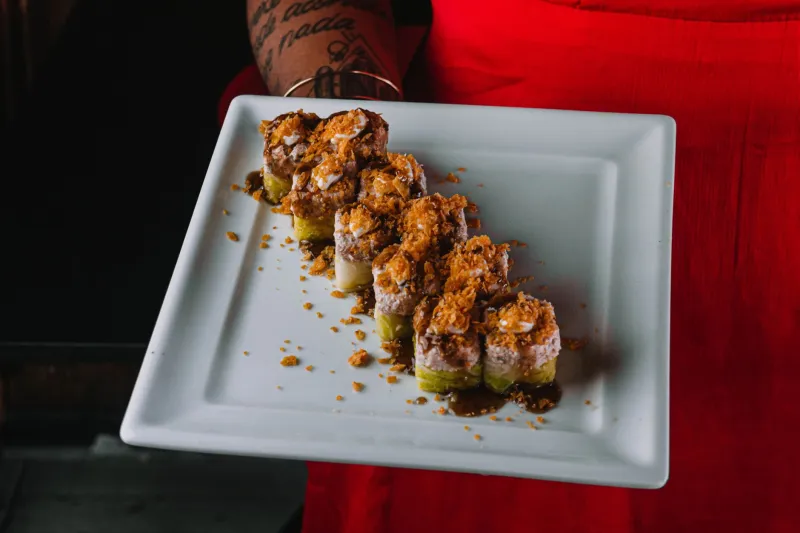
Tempura flakes (tenkasu) are arguably the most common. These tiny fried bits of batter have been used in Japanese cooking for centuries — you'll find them in traditional dishes like tanuki soba — but their role in modern sushi rolls as a textural topping is a more recent and decidedly Western evolution.
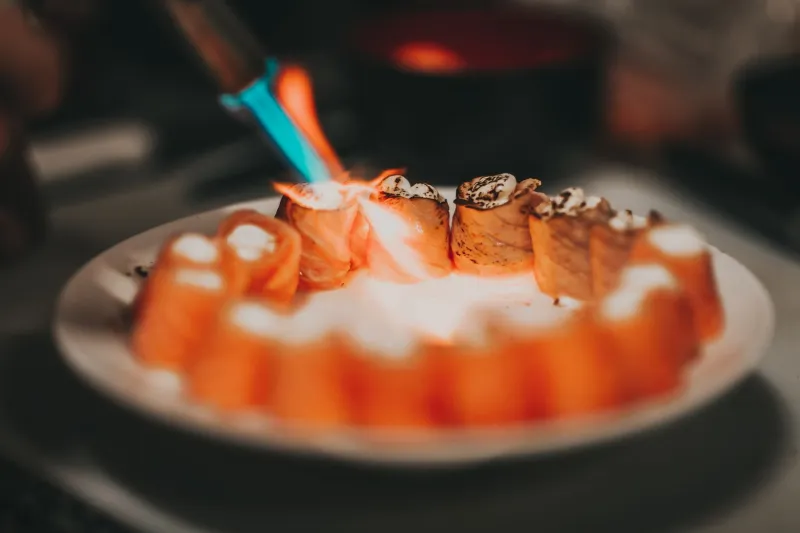
Torching creates a different kind of crunch: the caramelized, slightly crisped surface you get when a chef runs a blowtorch over the top of a roll or a piece of nigiri. It's not exactly crunchy in the potato chip sense, but it introduces a textural layer — a thin, almost lacquered exterior — that contrasts beautifully with the raw softness underneath.
Panko breadcrumbs have become a fusion staple, appearing in everything from baked rolls to crispy-fried specialty pieces. Panko is coarser and lighter than traditional Western breadcrumbs, which means it fries up with more air and surface area — more crunch per bite.
Crispy rice platforms, popularized by restaurants like Nobu, flip the script entirely by making the rice itself the crunchy element. Pressed sushi rice gets pan-fried until golden, then topped with spicy tuna or salmon. The result is something that feels almost like a tiny tostada — a direct American-Japanese mashup if there ever was one.
Fried onions, garlic chips, and sesame round out the toolkit, adding crunch that also brings flavor — savory, nutty, or sharp notes that layer onto the overall bite.
The Minimalism Pushback
Not everyone in the sushi world is celebrating this trend. Traditionalists — and there are plenty of them — argue that loading a roll with crispy toppings is a distraction from what sushi is supposed to be: a vehicle for showcasing the quality of the fish, the skill of the chef, and the integrity of the rice.
There's a legitimate point there. If you've ever had truly exceptional omakase sushi — the kind where a single piece of toro over perfectly seasoned rice is so good it makes you stop talking mid-sentence — you understand why adding crunch to that equation feels almost disrespectful.
But fusion chefs tend to see it as a different conversation entirely. "We're not trying to replace traditional sushi," says Chef Lena Park, who helms a Korean-Japanese fusion spot in Los Angeles. "We're creating a new lane. Our customers aren't choosing between us and Jiro's restaurant in Tokyo. They're choosing between us and every other exciting food experience in their city. And crunch is part of what makes an experience memorable."
Why American Diners Keep Coming Back for More
There's also something culturally specific happening here. American food culture has a deep, abiding love affair with crunch. From fried chicken to potato chips to the obsessive pursuit of the perfect crispy pizza crust, crunch signals indulgence, effort, and reward in a way that's particularly resonant for US diners.
When sushi — a cuisine that many Americans came to relatively late and sometimes found intimidating — started incorporating those familiar textural cues, it became more approachable without losing its sense of occasion. A spicy tuna crispy rice feels exciting and a little fancy, but it also feels fun in a way that can lower the barrier for someone who might have been nervous about raw fish.
That's not a compromise. That's smart design.
The Texture Is the Message
At the end of the day, the crunch craze in modern sushi isn't just about adding something crispy on top. It's about understanding that eating is a full sensory experience — and that deliberately engineering contrast, surprise, and layered sensation is its own form of culinary craft.
Traditional sushi masters built their art around precision and purity. Fusion chefs are building theirs around engagement and emotion. Both are legitimate pursuits. And if the result is a bite that makes you close your eyes for a second and just feel it — well, that's the whole point, isn't it?
Crunch on.